

As global users become increasingly dependent on smartphones, mobile phones are no longer just communication tools but essential devices for entertainment, work, social interactions, and learning. This high level of dependence has led to widespread “battery anxiety,” creating strong market demand and significant growth potential for the cell phone charging station industry. Overseas investors also view the phone charging locker business as a promising and high-growth market opportunity with substantial global profit potential.
As users spend more time on their phones and 5G networks accelerate power consumption, conventional charging efficiency can no longer meet the needs of fast charging scenarios.
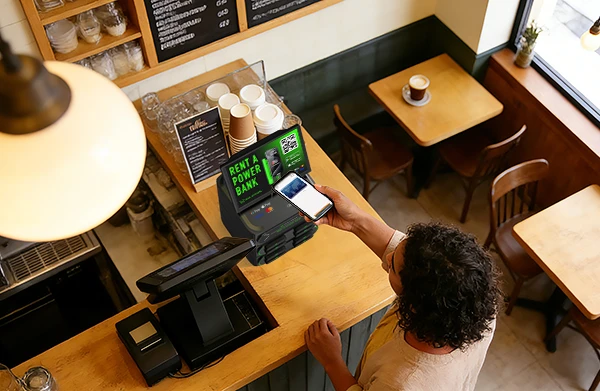
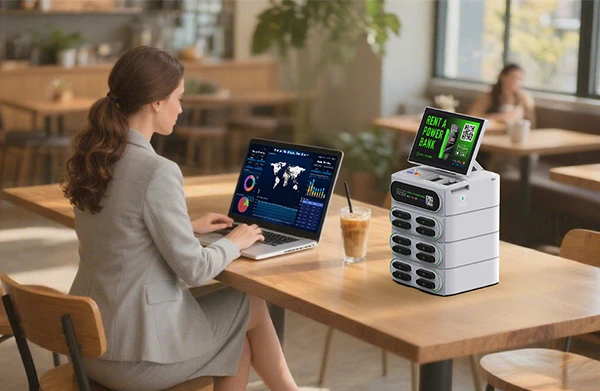
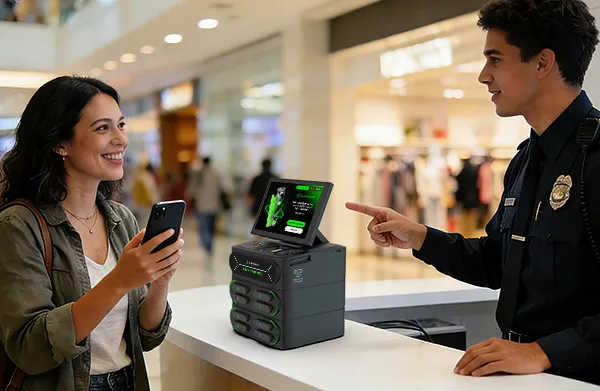
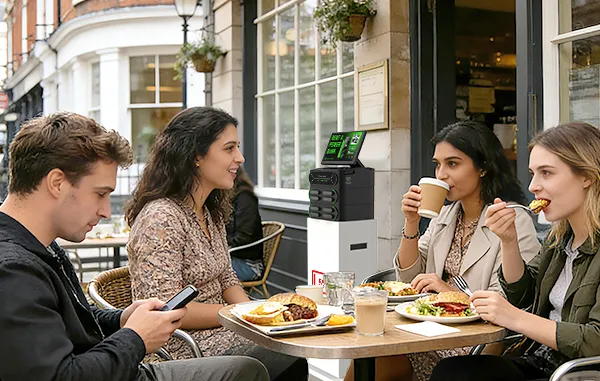
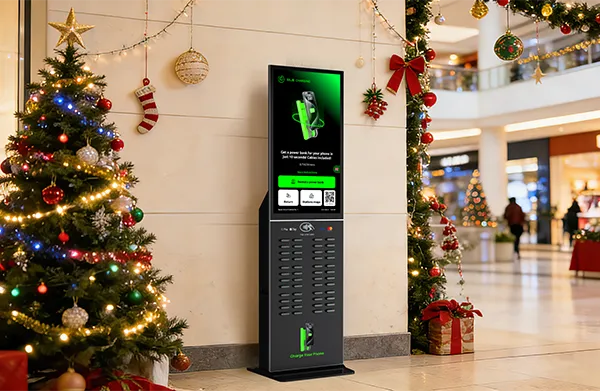
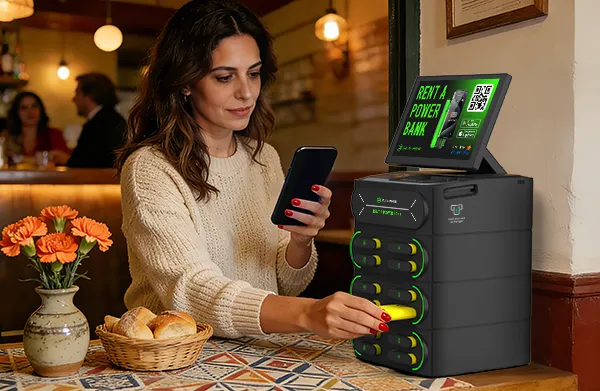
Driven by this demand, Fast-charging shared power banks have emerged, offering fast, efficient, and on-demand mobile charging services. Users don’t need to purchase a power bank; instead, they can simply scan a QR code to rent and return devices across malls, restaurants, airports, train stations, and other public venues.
1. What are the advantages of Fast-charging shared power banks?
- Faster charging and higher efficiency
Fast-charging shared power banks support higher power delivery with a maximum output of 22.5W, adopting PD protocols and offering flexible combinations (e.g., 5V/3.1A, 9V/2.2A, 12V/1.67A) to intelligently adapt to different devices. Users can top up their phones quickly during dining, shopping, or waiting, without disrupting their schedules or social activities.
- Widespread deployment and convenience
Power bank stations are deployed in high-traffic areas, allowing users to quickly locate a rental point whenever battery levels are low. With a simple scan-to-rent workflow, users can borrow and return at different locations. The phone charging station model provides seamless charging access and eliminates low-battery concerns during daily activities.
- Cost-efficient and environmentally friendly
Users pay only for usage without needing to own a power bank, making it more economical while reducing the hassle of carrying devices around. The on-demand rental model avoids low-frequency usage waste after purchase, ultimately saving resources and improving efficiency.
- Strong compatibility, wider application
With two charging interfaces (Type-C and Lightning), these devices support most mainstream smartphones and accessories such as Bluetooth earbuds. The system intelligently identifies and outputs optimized charging power, ensuring a smooth charging experience.
2. Why Fast-charging shared power banks help investors make money
- Higher turnover rate, greater profitability
Fast-charging shared power banks can charge up to 60% in 30 minutes—approximately 30% faster than conventional power bank vending machines. For users with urgent charging needs, fast charging significantly reduces waiting time.
A typical rental power bank may serve 3–6 users per day, whereas Fast-charging shared power banks may serve 5–10 or more. Faster charging shortens user occupancy time, enabling more daily rentals and improving device utilization and unit-time revenue.
- Optimized asset allocation and shorter payback cycles
By deploying Fast-charging shared power banks, investors significantly improve device turnover rates and maximize asset value. Higher utilization reduces investment risk, shortens ROI cycles, and frees up capital for expanding the power bank rental station business.
- Access to high-value scenarios and broader user groups
Traditional shared power banks perform better in long-stay venues. However, when traveling or commuting between cities, users may hesitate to rent due to limited pickup/return points.
Fast-charging shared power banks solve short-stay and urgent charging scenarios and open new markets. In airports, train stations, subways, and transportation hubs, travelers and business users have high charging expectations. Fast charging meets immediate mobility needs and emergency scenarios with greater efficiency.

Investing in Fast-charging shared power banks helps investors secure future market opportunities, enhancing long-term growth potential and competitive advantages.
Conclusion
Rising smartphone usage and 5G-driven power consumption have made conventional charging solutions insufficient for modern demand. Fast-charging cell phone charge stations provide high-efficiency, on-demand charging services for mobile users.
By significantly increasing device turnover and serving more users within the same time frame, fast-charging power banks unlock scale efficiency and profitability for investors. Additionally, fast-charging solutions enable expansion into high-value scenarios, capture first-mover advantages, and deliver long-term market growth potential and competitive benefits for the power bank rental business.
January 22, 2026